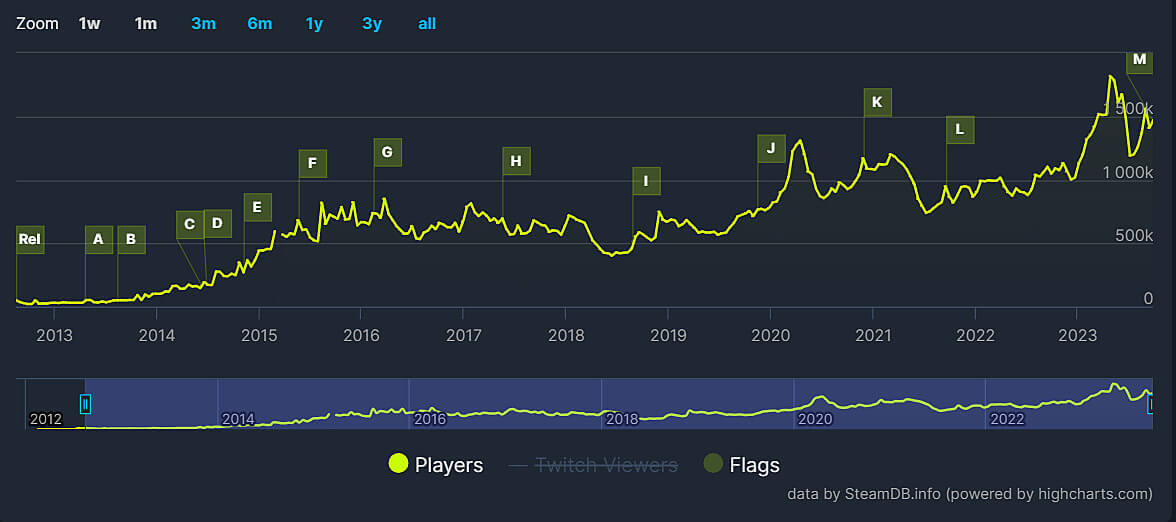
In the dynamic world of Counter-Strike 2, statistics are far more than just numbers; they are the key to understanding the game, analyzing performance, and improving strategically. Whether you are a casual player or an aspiring professional, knowing the daily, weekly, monthly, and yearly player statistics, as well as your personal in-game metrics, can give you a decisive advantage.
The CS2 Player Base: An Overview
Counter-Strike 2 continues to attract a massive global player base. Current data shows that hundreds of thousands of players are online every day, with peak numbers regularly exceeding the one-million mark. For example, on June 3, 2026, CS2 recorded a peak of 1,442,979 players within a 24-hour period. The average monthly player count also remains in the high millions, highlighting the game's ongoing popularity. Services such as ActivePlayer.io, SteamDB, and Tracker.gg provide real-time insights into these player numbers and often report peaks of more than 1.4 million concurrent players. In January 2026, CS2 even reached a new record for average player count, with nearly 1.1 million players over the previous 30 days.
These numbers are not only impressive but also crucial for the gaming experience. A large player base means shorter matchmaking queues and a wider selection of opponents and teammates, resulting in fairer and more exciting matches. The highest player counts are often reached on weekends and during prime time in Europe (6:00 PM – 11:00 PM CET) and North America (7:00 PM – 12:00 AM EST).
Understanding and Using In-Game Statistics
In addition to global player numbers, your individual in-game statistics are of utmost importance. The CS2 scoreboard provides a wealth of information that reflects your performance in every match. The most important metrics include:
These statistics help you identify strengths and weaknesses. A high HS% indicates strong aiming accuracy, while a high UD shows that you are using your utility effectively. It is important to note that statistics do not always tell the full story; strategic contributions such as throwing a game-changing smoke grenade or holding a crucial position are not directly reflected on the scoreboard.
Third-Party Tools for Detailed Analysis
To gain a deeper understanding of their performance, many players use external statistics trackers. These platforms often provide more detailed infographics and analyses than the data available in-game. Popular tools include:
These trackers can help you identify patterns in your gameplay, such as the positions where you die most often or which weapons you use most effectively. They are essential for anyone who wants to seriously improve their game.
The Importance of Statistics in the Competitive Scene
In esports, statistics form the foundation of every analysis. Sites such as HLTV.org and Liquipedia are indispensable resources for fans and analysts who want to track the performance of professional players and teams. Here you can find rankings, player profiles with historical data, and detailed tournament statistics. This data makes it possible to identify trends, evaluate the form of teams, and make predictions about future matches.
Statistical analysis is also crucial for teams themselves when refining strategies, deciding map picks, and assigning roles. Understanding these metrics not only helps with personal improvement but also enhances team coordination and communication.
Videos & Additional Links
Videos & weiterführende Links
Hier findest du passende Videos und Ressourcen zum Thema:
Comments
Sign in with Steam to comment